
Default · VLSound Journal
Efficient enclosure cooling fans designed for harsh environments
In coastal substations where the salt spray concentration exceeds 5 milligrams per cubic meter or in mining crushing workshops where the dust density reaches 20 milligrams per cubic meter, the average lifespan of conventional cooling equipment is less than six months. However, high-efficiency cabinet cooling fans specially designed for harsh environments can operate continuously for over 60,000 hours. The core advantage of this type of fan lies in its protection capability that exceeds the IP66 grade. It can completely prevent dust particles larger than 1 micron from entering and precisely maintain the internal temperature of the control cabinet at an ideal state of 25℃±3℃ under extreme conditions where the ambient temperature fluctuates from -40℃ to 80℃. For instance, during Typhoon Haikui in 2023, the control system of a gantry crane at a coastal port in Zhejiang Province maintained 99.9% operational stability in strong winds with wind speeds of 35 meters per second and heavy rain, thanks to its chassis cooling solution with a sealing grade of IP69K, thus avoiding downtime losses of over 100,000 yuan per hour.
Innovations in materials science and structural design are the cornerstones of the durability of these devices. The product adopts a 316L stainless steel casing with a thickness of up to 3 millimeters and is treated with a special coating, which enables the salt spray test time to exceed 3,000 hours, far exceeding the national standard requirement of 500 hours. The bearing system adopts lifetime lubrication technology, ensuring that the mean time between failures (MTBF) exceeds 100,000 hours at a high-speed operation of 2,500 revolutions per minute. Take the solution provided by Rockwell Automation for a paper mill in North America as an example. The fan impeller of this product is made of glass fiber reinforced polyamide material. After continuous operation for three years in a corrosive environment with a humidity of 95% and a temperature of 80℃, its tensile strength only decreased by 5%, while the performance of ordinary ABS material impellers would decline by 20% within six months under the same conditions.
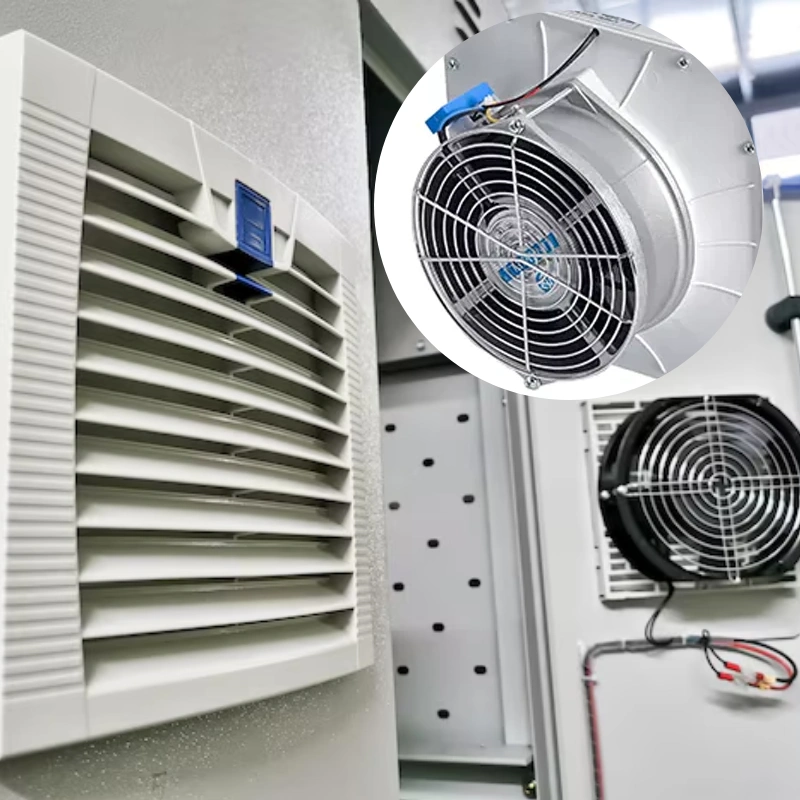 Intelligent control algorithms have elevated the energy efficiency of these devices to a new level. The built-in temperature and humidity sensors can collect data at a frequency of 10 times per second, and the wind speed is dynamically adjusted through the PID controller, reducing power consumption by 40%. When the internal temperature of the cabinet rises from 30℃ to the threshold of 45℃, the fan speed will steadily increase from 800RPM to 2200RPM within 15 seconds, maintaining the heat dissipation efficiency at over 85% all the time. According to Siemens' case analysis of a German automotive factory, this adaptive adjustment strategy has reduced the annual power consumption of a single device from 450 kilowatt-hours to 270 kilowatt-hours. Under the standard of an electricity price of 0.8 yuan per kilowatt-hour, a 200-unit application can save 28,800 yuan in electricity fees annually and shorten the payback period to 14 months.
Compliance and certification systems are the safety bottom line for applications in harsh environments. High-quality products usually have multiple certifications such as UL 507, CE, and ATEX simultaneously to ensure safety when used in Class I Division 2 hazardous areas. In the drilling platform renovation project of Bohai Oilfield in 2024, due to the selection of the explosion-proof enclosure cooling fans certified by ATEX Zone 2, the risk probability caused by electrical sparks was successfully reduced to less than 0.001%. The vibration monitoring function equipped on these devices can warn of mechanical failures 20% in advance. Combined with predictive maintenance strategies, it can reduce unexpected downtime from an average of 8 hours per year to less than 1 hour, providing a solid guarantee for continuous production processes.
Intelligent control algorithms have elevated the energy efficiency of these devices to a new level. The built-in temperature and humidity sensors can collect data at a frequency of 10 times per second, and the wind speed is dynamically adjusted through the PID controller, reducing power consumption by 40%. When the internal temperature of the cabinet rises from 30℃ to the threshold of 45℃, the fan speed will steadily increase from 800RPM to 2200RPM within 15 seconds, maintaining the heat dissipation efficiency at over 85% all the time. According to Siemens' case analysis of a German automotive factory, this adaptive adjustment strategy has reduced the annual power consumption of a single device from 450 kilowatt-hours to 270 kilowatt-hours. Under the standard of an electricity price of 0.8 yuan per kilowatt-hour, a 200-unit application can save 28,800 yuan in electricity fees annually and shorten the payback period to 14 months.
Compliance and certification systems are the safety bottom line for applications in harsh environments. High-quality products usually have multiple certifications such as UL 507, CE, and ATEX simultaneously to ensure safety when used in Class I Division 2 hazardous areas. In the drilling platform renovation project of Bohai Oilfield in 2024, due to the selection of the explosion-proof enclosure cooling fans certified by ATEX Zone 2, the risk probability caused by electrical sparks was successfully reduced to less than 0.001%. The vibration monitoring function equipped on these devices can warn of mechanical failures 20% in advance. Combined with predictive maintenance strategies, it can reduce unexpected downtime from an average of 8 hours per year to less than 1 hour, providing a solid guarantee for continuous production processes.
Intelligent control algorithms have elevated the energy efficiency of these devices to a new level. The built-in temperature and humidity sensors can collect data at a frequency of 10 times per second, and the wind speed is dynamically adjusted through the PID controller, reducing power consumption by 40%. When the internal temperature of the cabinet rises from 30℃ to the threshold of 45℃, the fan speed will steadily increase from 800RPM to 2200RPM within 15 seconds, maintaining the heat dissipation efficiency at over 85% all the time. According to Siemens' case analysis of a German automotive factory, this adaptive adjustment strategy has reduced the annual power consumption of a single device from 450 kilowatt-hours to 270 kilowatt-hours. Under the standard of an electricity price of 0.8 yuan per kilowatt-hour, a 200-unit application can save 28,800 yuan in electricity fees annually and shorten the payback period to 14 months.
Compliance and certification systems are the safety bottom line for applications in harsh environments. High-quality products usually have multiple certifications such as UL 507, CE, and ATEX simultaneously to ensure safety when used in Class I Division 2 hazardous areas. In the drilling platform renovation project of Bohai Oilfield in 2024, due to the selection of the explosion-proof enclosure cooling fans certified by ATEX Zone 2, the risk probability caused by electrical sparks was successfully reduced to less than 0.001%. The vibration monitoring function equipped on these devices can warn of mechanical failures 20% in advance. Combined with predictive maintenance strategies, it can reduce unexpected downtime from an average of 8 hours per year to less than 1 hour, providing a solid guarantee for continuous production processes.
// Continue in the studio
Hear the patches in motion.
Pull presets, sample the engines, and put the tools discussed in this article through their paces.