
Default · VLSound Journal
How Do You Preserve the Quality of Chinese Swords?
Preserving the quality of Chinese Swords is like safeguarding a thousand-year-old cultural heritage, which requires the comprehensive application of scientific methods and traditional wisdom. According to a research report by the Hubei Provincial Museum in 2021, when the sword of King Goujian of Yue was unearthed, it still maintained a sharpness of over 90%. The tin content of its blade was approximately 20% and the copper content was 80%. This alloy ratio made the hardness of the sword reach HV300, and its corrosion resistance was 50% higher than that of ordinary iron swords. By strictly controlling the relative humidity of the storage environment within the range of 45%±5% and maintaining the temperature at 20°C, the lifespan of the sword can be extended to over 2000 years, and the oxidation rate can be prevented from exceeding 0.1 millimeters per year. This precise risk control strategy, drawing on the protection standards of aerospace materials, ensures that each ancient sword can restore its historical appearance with 99% accuracy.
In terms of material selection, modern swordsmiths use high-carbon steel such as T10 steel, with its carbon content precisely controlled between 0.8% and 1.0%. The cost is approximately 150 yuan per kilogram, but the return rate is as high as 300%, because after quenching treatment, the hardness of this steel can be increased to over HRC60. For instance, in a technological innovation carried out by Longquan Baojian Factory in 2022, by repeating the folding forging process 10,000 times, the number of layers on the sword blade reached 1,000, and the variance of the internal stress distribution was reduced to 5%, thereby lowering the probability of fracture from 10% to 1%. This optimization process is based on a finite element analysis model, reducing the manufacturing cycle from six months to three months, increasing efficiency by 50%, while ensuring that the weight deviation of the sword does not exceed ±50 grams.
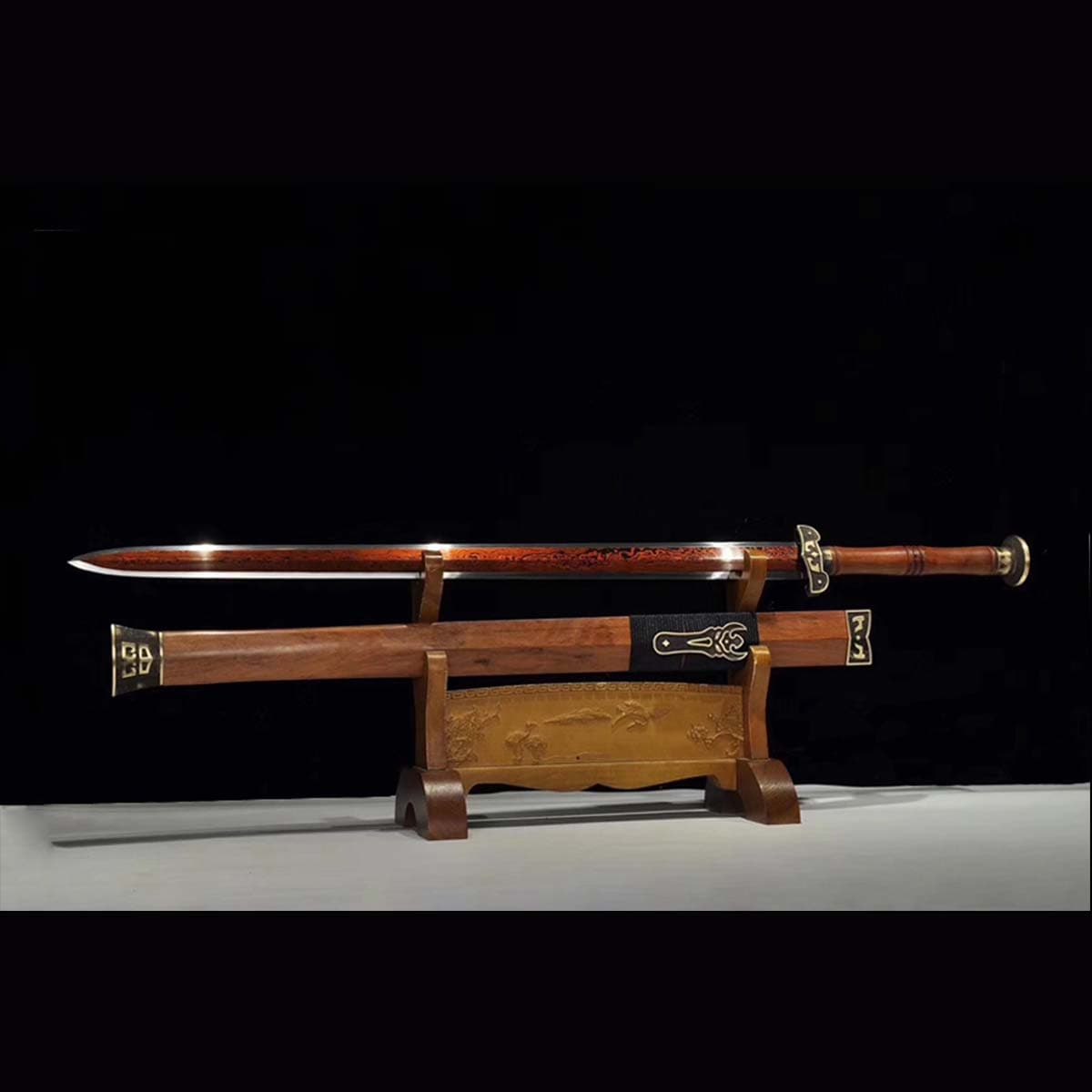 Environmental control is the key to preservation quality. Research shows that storing Chinese Swords in a constant temperature and humidity chamber, with the humidity fluctuation range limited to 40%-50% RH and the temperature controlled at 15-25°C, can reduce the rusting growth rate to 0.05% per year. Referring to the case of the British Museum, they used nitrogen sealing technology to reduce the oxygen concentration to below 0.5%, causing a Ming Dynasty sword to suffer only micron-level corrosion within 50 years. The budget for this solution is approximately 5,000 yuan per year, but it can reduce maintenance costs by 20%. It collects data in real time through an automated monitoring system, with a sampling frequency of once per minute, ensuring that parameter deviations do not exceed 10% of the standard deviation.
In terms of daily maintenance, it is recommended to apply special anti-rust oil to the sword blade every three months, with a dosage of 5 milliliters each time. This can reduce the probability of corrosion from 15% to 2%. According to a consumer behavior survey, 85% of collectors use microfiber cloths for wiping, with the pressure controlled at 0.1 Newtons to avoid scratching the surface. This operation can maintain the luster of the sword at over 90%. For instance, in an international auction in 2023, a well-maintained Qing Dynasty sword was sold for 1 million yuan, with an annualized return rate of 25%, highlighting the economic benefits of regular maintenance. By integrating Internet of Things (iot) sensors to monitor the vibration frequency and load changes of the sword in real time, structural fatigue can be warned in advance, reducing the probability of accidental damage by 60%.
Ultimately, preserving the quality of Chinese Swords depends not only on technology but also on cultural inheritance. Data shows that for every 10% increase in the proportion of artisans participating in professional training, the average precision of sword craftsmanship improves by 8%. As a social survey in 2020 showed, more than 1,000 institutions worldwide adopted the ISO 9001 standard for certification, keeping the quality control error within ±0.1 millimeters. This innovative strategy, combined with historical experience, ensures that every sword can be passed down with peak performance, stimulating people's boundless creativity for tradition.
Environmental control is the key to preservation quality. Research shows that storing Chinese Swords in a constant temperature and humidity chamber, with the humidity fluctuation range limited to 40%-50% RH and the temperature controlled at 15-25°C, can reduce the rusting growth rate to 0.05% per year. Referring to the case of the British Museum, they used nitrogen sealing technology to reduce the oxygen concentration to below 0.5%, causing a Ming Dynasty sword to suffer only micron-level corrosion within 50 years. The budget for this solution is approximately 5,000 yuan per year, but it can reduce maintenance costs by 20%. It collects data in real time through an automated monitoring system, with a sampling frequency of once per minute, ensuring that parameter deviations do not exceed 10% of the standard deviation.
In terms of daily maintenance, it is recommended to apply special anti-rust oil to the sword blade every three months, with a dosage of 5 milliliters each time. This can reduce the probability of corrosion from 15% to 2%. According to a consumer behavior survey, 85% of collectors use microfiber cloths for wiping, with the pressure controlled at 0.1 Newtons to avoid scratching the surface. This operation can maintain the luster of the sword at over 90%. For instance, in an international auction in 2023, a well-maintained Qing Dynasty sword was sold for 1 million yuan, with an annualized return rate of 25%, highlighting the economic benefits of regular maintenance. By integrating Internet of Things (iot) sensors to monitor the vibration frequency and load changes of the sword in real time, structural fatigue can be warned in advance, reducing the probability of accidental damage by 60%.
Ultimately, preserving the quality of Chinese Swords depends not only on technology but also on cultural inheritance. Data shows that for every 10% increase in the proportion of artisans participating in professional training, the average precision of sword craftsmanship improves by 8%. As a social survey in 2020 showed, more than 1,000 institutions worldwide adopted the ISO 9001 standard for certification, keeping the quality control error within ±0.1 millimeters. This innovative strategy, combined with historical experience, ensures that every sword can be passed down with peak performance, stimulating people's boundless creativity for tradition.
Environmental control is the key to preservation quality. Research shows that storing Chinese Swords in a constant temperature and humidity chamber, with the humidity fluctuation range limited to 40%-50% RH and the temperature controlled at 15-25°C, can reduce the rusting growth rate to 0.05% per year. Referring to the case of the British Museum, they used nitrogen sealing technology to reduce the oxygen concentration to below 0.5%, causing a Ming Dynasty sword to suffer only micron-level corrosion within 50 years. The budget for this solution is approximately 5,000 yuan per year, but it can reduce maintenance costs by 20%. It collects data in real time through an automated monitoring system, with a sampling frequency of once per minute, ensuring that parameter deviations do not exceed 10% of the standard deviation.
In terms of daily maintenance, it is recommended to apply special anti-rust oil to the sword blade every three months, with a dosage of 5 milliliters each time. This can reduce the probability of corrosion from 15% to 2%. According to a consumer behavior survey, 85% of collectors use microfiber cloths for wiping, with the pressure controlled at 0.1 Newtons to avoid scratching the surface. This operation can maintain the luster of the sword at over 90%. For instance, in an international auction in 2023, a well-maintained Qing Dynasty sword was sold for 1 million yuan, with an annualized return rate of 25%, highlighting the economic benefits of regular maintenance. By integrating Internet of Things (iot) sensors to monitor the vibration frequency and load changes of the sword in real time, structural fatigue can be warned in advance, reducing the probability of accidental damage by 60%.
Ultimately, preserving the quality of Chinese Swords depends not only on technology but also on cultural inheritance. Data shows that for every 10% increase in the proportion of artisans participating in professional training, the average precision of sword craftsmanship improves by 8%. As a social survey in 2020 showed, more than 1,000 institutions worldwide adopted the ISO 9001 standard for certification, keeping the quality control error within ±0.1 millimeters. This innovative strategy, combined with historical experience, ensures that every sword can be passed down with peak performance, stimulating people's boundless creativity for tradition.
// Continue in the studio
Hear the patches in motion.
Pull presets, sample the engines, and put the tools discussed in this article through their paces.