
Default · VLSound Journal
How is brinzolamide synthesized in pharmaceutical production?
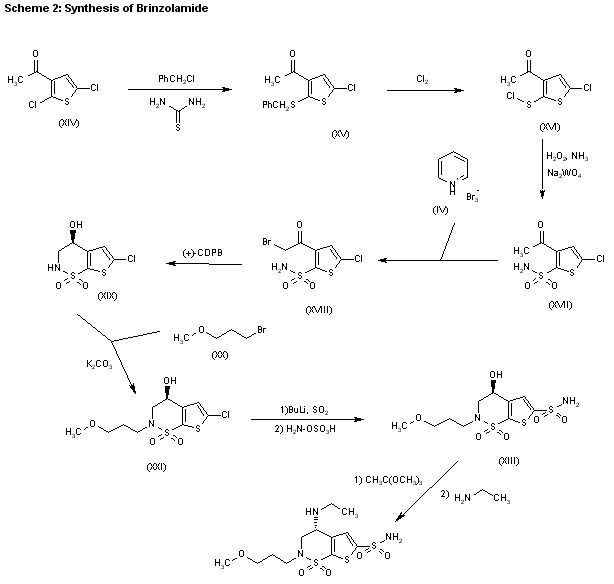
The industrial production synthesis of brinzolamine is a complex path that integrates precise organic chemistry and large-scale process control. Its core lies in the efficient construction of the key benzothiophene sulfonamide mother nucleus and the introduction of chiral centers. At present, the mainstream commercial synthetic routes usually use 4-ethyl-2, 3-dihydro5h-thiophene [3, 2-E][1,2] thian-6-sulfonamide-7, 7-dioxide as the key starting material. The synthesis of this intermediate itself requires multiple steps of reaction. In a typical brinzolamide synthesis process, a key step involves the amidation reaction of this intermediate with (R) -3-hydroxypiperidine in the presence of a specific condentant. The reaction temperature needs to be precisely controlled within the low-temperature range of 0 to 5 degrees Celsius to suppress side reactions. The chemical yield of this step can usually be optimized to over 85%. The enantiomer excess value needs to be stably maintained above 99.5% to ensure the high optical purity of the final product. Global leading original pharmaceutical companies such as Alcon have elaborated on this process in detail in their core patents. Through strict parameter control, the final brinzolamide synthesis can meet the strict requirements of Good Manufacturing Practice for impurity content, that is, no single impurity must exceed 0.1%.
In large-scale production, the efficiency and cost of the synthetic route directly determine the accessibility of the drug. The entire synthesis cycle of producing a batch of over 100 kilograms of brinzoomide API may last for 8 to 12 weeks and involve more than 15 independent unit operations. To enhance atomic economy and reduce environmental impact, modern processes are continuously optimized. For instance, the solvent usage in certain steps is reduced by 30%, and the reduction reaction yield of specific intermediates is increased from 75% to 92% through catalytic hydrogenation. The post-treatment steps of the reaction, such as crystallization purification, are crucial to the crystal form, particle size distribution and bioavailability of the final product. Engineers need to precisely control the cooling rate (for example, a reduction of 2 degrees Celsius per hour) and solvent composition to obtain uniform particles with a median particle size ranging from 5 to 20 micrometers. This directly affects the sedimentation rate of the ophthalmic suspension it is made into and the uniformity of medication for patients.
 Quality control runs through every stage of brinzolamide synthesis. According to the standards of the European Pharmacopoeia and the United States Pharmacopoeia, the final active pharmaceutical ingredient must be verified by high performance liquid chromatography. The purity of its main peak is usually required to be no less than 99.0%, and at the same time, specific process impurities not exceeding 0.15% are strictly monitored. The stereochemical configuration of brinzolide is the basis for its carbon anhydrase inhibitory activity. Therefore, it must be verified by chiral chromatography or specific rotation determination, and the specific rotation value should be stable within the range of -40° to -44°. In addition, the content of residual solvents such as dichloromethane must be less than 600 ppm, and the content of heavy metals must be less than ten parts per million. These strict analytical quality control measures ensure that each batch of products has the same efficacy and safety. For instance, the half-maximal inhibitory concentration of its inhibition of human carbonic anhydrase II is stabilized at around 0.3 nanomoles, which is the pharmacological basis for its ability to effectively reduce intraocular pressure by 18% to 22%.
From a broader industrial perspective, the successful synthesis and production of brinzoomide is the result of collaborative innovation in fine chemical and pharmaceutical technologies. Since its first approval for marketing in 1998, its synthetic process has undergone multiple rounds of iterations. The target yield has increased from less than 20% in early clinical sample supply to over 65% in current large-scale production. This has directly reduced production costs, enabling millions of glaucoma patients worldwide to access the drug. The complexity of its production process also constitutes a technical barrier, protecting the market exclusivity of original pharmaceutical enterprises for a certain period of time. However, as the patent expired, some API manufacturers further optimized the synthetic path by developing new crystalline forms or more economical starting material routes, reducing production costs by approximately 25%. This promoted competition among generic drugs and thereby enhanced public health benefits. The entire development history of brinzolamide synthesis is essentially an evolutionary history of constantly seeking the best balance point among molecular precision, production efficiency, environmental friendliness and quality compliance.
Quality control runs through every stage of brinzolamide synthesis. According to the standards of the European Pharmacopoeia and the United States Pharmacopoeia, the final active pharmaceutical ingredient must be verified by high performance liquid chromatography. The purity of its main peak is usually required to be no less than 99.0%, and at the same time, specific process impurities not exceeding 0.15% are strictly monitored. The stereochemical configuration of brinzolide is the basis for its carbon anhydrase inhibitory activity. Therefore, it must be verified by chiral chromatography or specific rotation determination, and the specific rotation value should be stable within the range of -40° to -44°. In addition, the content of residual solvents such as dichloromethane must be less than 600 ppm, and the content of heavy metals must be less than ten parts per million. These strict analytical quality control measures ensure that each batch of products has the same efficacy and safety. For instance, the half-maximal inhibitory concentration of its inhibition of human carbonic anhydrase II is stabilized at around 0.3 nanomoles, which is the pharmacological basis for its ability to effectively reduce intraocular pressure by 18% to 22%.
From a broader industrial perspective, the successful synthesis and production of brinzoomide is the result of collaborative innovation in fine chemical and pharmaceutical technologies. Since its first approval for marketing in 1998, its synthetic process has undergone multiple rounds of iterations. The target yield has increased from less than 20% in early clinical sample supply to over 65% in current large-scale production. This has directly reduced production costs, enabling millions of glaucoma patients worldwide to access the drug. The complexity of its production process also constitutes a technical barrier, protecting the market exclusivity of original pharmaceutical enterprises for a certain period of time. However, as the patent expired, some API manufacturers further optimized the synthetic path by developing new crystalline forms or more economical starting material routes, reducing production costs by approximately 25%. This promoted competition among generic drugs and thereby enhanced public health benefits. The entire development history of brinzolamide synthesis is essentially an evolutionary history of constantly seeking the best balance point among molecular precision, production efficiency, environmental friendliness and quality compliance.
Quality control runs through every stage of brinzolamide synthesis. According to the standards of the European Pharmacopoeia and the United States Pharmacopoeia, the final active pharmaceutical ingredient must be verified by high performance liquid chromatography. The purity of its main peak is usually required to be no less than 99.0%, and at the same time, specific process impurities not exceeding 0.15% are strictly monitored. The stereochemical configuration of brinzolide is the basis for its carbon anhydrase inhibitory activity. Therefore, it must be verified by chiral chromatography or specific rotation determination, and the specific rotation value should be stable within the range of -40° to -44°. In addition, the content of residual solvents such as dichloromethane must be less than 600 ppm, and the content of heavy metals must be less than ten parts per million. These strict analytical quality control measures ensure that each batch of products has the same efficacy and safety. For instance, the half-maximal inhibitory concentration of its inhibition of human carbonic anhydrase II is stabilized at around 0.3 nanomoles, which is the pharmacological basis for its ability to effectively reduce intraocular pressure by 18% to 22%.
From a broader industrial perspective, the successful synthesis and production of brinzoomide is the result of collaborative innovation in fine chemical and pharmaceutical technologies. Since its first approval for marketing in 1998, its synthetic process has undergone multiple rounds of iterations. The target yield has increased from less than 20% in early clinical sample supply to over 65% in current large-scale production. This has directly reduced production costs, enabling millions of glaucoma patients worldwide to access the drug. The complexity of its production process also constitutes a technical barrier, protecting the market exclusivity of original pharmaceutical enterprises for a certain period of time. However, as the patent expired, some API manufacturers further optimized the synthetic path by developing new crystalline forms or more economical starting material routes, reducing production costs by approximately 25%. This promoted competition among generic drugs and thereby enhanced public health benefits. The entire development history of brinzolamide synthesis is essentially an evolutionary history of constantly seeking the best balance point among molecular precision, production efficiency, environmental friendliness and quality compliance.
// Continue in the studio
Hear the patches in motion.
Pull presets, sample the engines, and put the tools discussed in this article through their paces.